|

Definition [J]
Business-Knowledge Architecture & Governance
The effective value of the enterprise is its knowledge, the potential sum of knowledge
and understanding of everyone and everything that has ever been contributed to it,
or that it has experienced in any way, as well as what knowledge it can infer from
this knowledge.
Issues
Effectively managing its knowledge is key to the enterprise success, and failure.
Issues typically range through acquiring, cleaning, maintaining, digitizing, structuring,
modeling, transforming, persisting, indexing, retrieving, presenting, processing,
sharing, securing, using, ..., so that this most precious value can adequately blossom
in/for the enterprise and its purpose and action.
Design
Current trends tend to define relatively arbitrary initial or reference semantics,
irrespective of the natural structure and operation of knowledge.
Implementation
In fact, it often seems that enterprise knowledge is typically reduced to some rather
static information stored in a database reference system, providing some access to
some humans.
Ontology
Ontology can be used to try to better organize and provide access to enterprise knowledge.
Ontology provides some common understanding for terms referring to some reality, at
some point in time, about which knowledge is to be entered and accessed.
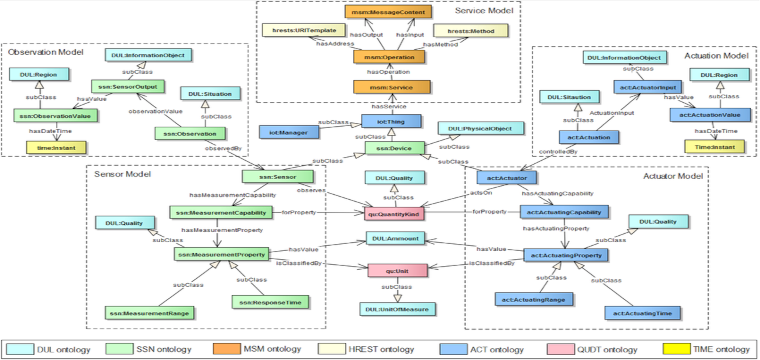
Ontology Model
Understanding
In such context, of arbitrary semantics, may they be rather light like in RDF, or
heavier with more elaborate ontology, for example, in any case, they are arbitrary
or convention-based, even and especially at the root and core concept levels. With
roots that are not optimally congruent with the natural structure and operation of
knowledge, typically from a lack of understanding of the natural knowledge phenomenon,
most enterprise knowledge management is expensive and clearly sub-optimal:
- Ontology discussion can last for very long time on even basic concepts
- The representation remains arbitrary, imposing constraints that tend to grow with
time and evolution
- Compatibility and exchange remain difficult, and most of all
- Computing system cannot contribute at the enterprise knowledge level
- Making human-system interfaces more limited, increasing complexity
- Preventing governance and governance automation
- ...
Example
This domain is vast and cases can differ, but, for a simple example, in a way, RDF,
owing much to relational Entities and Relations, defines relations as links, urls
to be more specific. where nodes can be attached to try to define the relation type,
which is definately insufficient to support effective knowledge relationships, at
least natively.
One could try to create complex RDF structures to better reflect a knowledge relationship,
only to build more arbitrary monoliths, with worse interfaces, no compatibility, and
much increased complexity. OOP, RDF, ontologies and other approaches lack congruence
with the reality and knowledge phemomena structure and operation.
Much like Icarius and others trying to fly without a deep enough understanding of
the structure and operation of all the implied phenomena including: aerodynamics,
fluids, mass, energy, materials, propulsion, etc.
Arbitrary
Misunderstanding the natural structure and operation of knowledge has lead to arbitrary
foundations, tools, and semantics, often based on the decision of some individual,
others to try to fit each's interpretation of its reality, into the arbitrary model
available.
Natural
Both reality and knowledge are natural phenomena that were not arbitrary created by
humans. Properly understanding them is key to trying to manage them.
|
