|

Definition [F]
The [A], [B], [C], [D], [E] definitions above, could be combined into this [F] definition
which may help better consider how knowledge effectively operates.
Knowledge can include infinite layers and can be processed in many ways, but at its
core, it is founded on two basic principles: qualification and resource structuring.
Qualification
As everything is relative, so is knowledge and so are minds. Hence the basic knowledge
operation is comparing, where every comparison produces qualifications that qualify
the relation between the compared entities, and where the compared entities are prior
qualifications themselves. In knowledge, everything is qualification. For example,
a verb is in fact a qualification for an action, while nouns are identity qualifiers.
Resources
Qualifications do not typically stand alone, they are networked into collections of
qualifications. Identified qualification collections are typically referred to as
knowledge resources. Knowledge resources are related together by other relations and
identified groups of related resources are also knowledge resources. There is no limit
as to how deep knowledge resources can be nested like this.
Resources are manageable chunks or entities. Knowledge cannot be managed as a whole.
The primary qualification to manage resources is identification. If it can't be identified,
it can't be managed. Hence, identification is the premier form of qualification. There
are different types of identification and resources often use more than one.
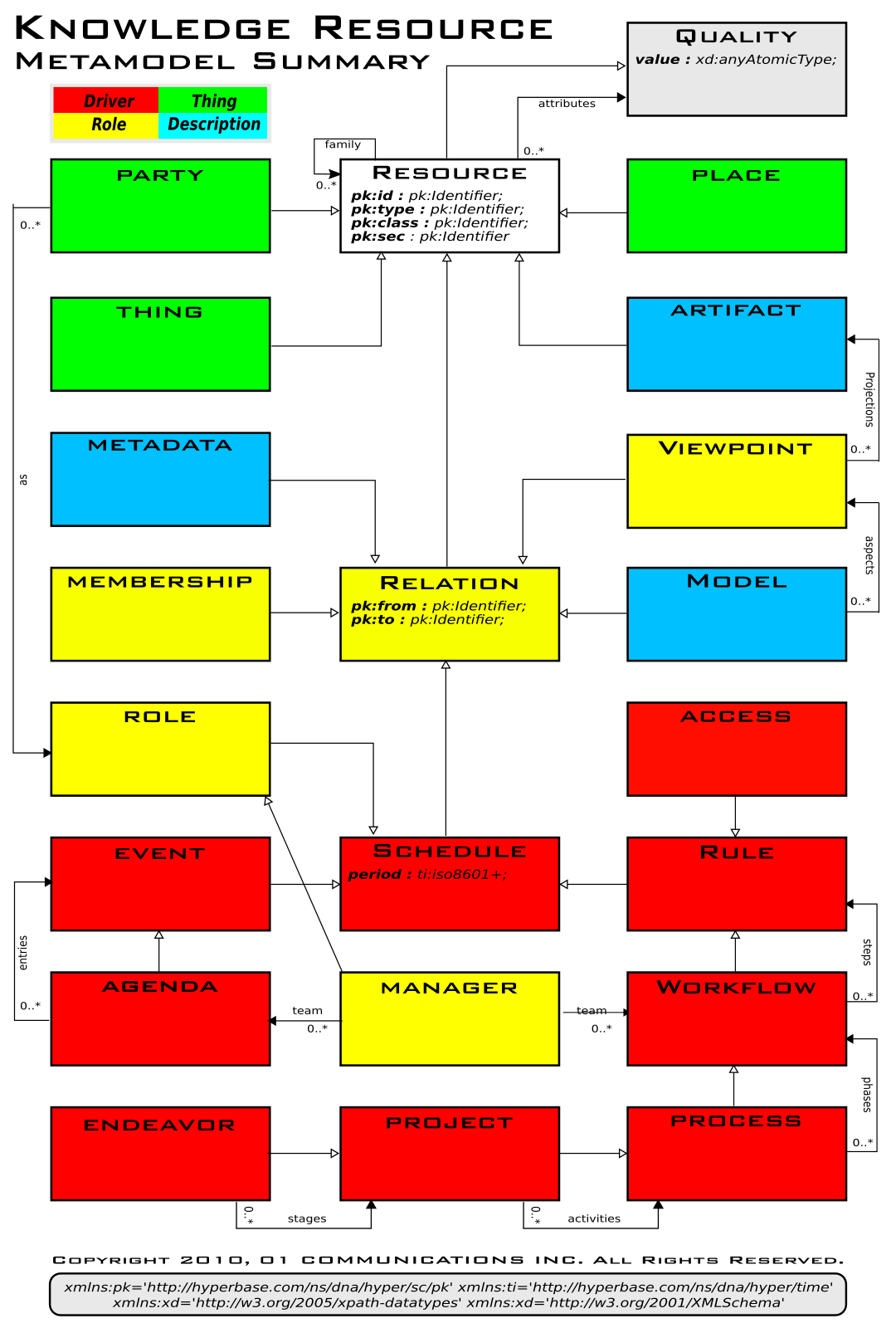
Quality
Each qualification instance, typically referred to as a Quality, defines or rather
qualifies an aspect of a resource. The more standard forms of qualifications can include
identification, grouping, location, storage, period, reference, documentation, value,
behavior, indicator (as in KPIs, for example), etc.
Governance
Governance is automated with resource behavior controls and dynamic KPIs traversing
related resources.
Patterns
Qualifications and resources constitute patterns that could be compared to neuron
firing patterns.
Relationships
Resources qualify entities and relationships. Relationships are resources that define,
qualify, and manage relationships between resources. Relationships are key to knowledge,
hence they are the most important or common knowledge resource archetype. Multilateral
relationships are really collections of unidirectional relationships.
Archetypes
There are many more resource archetypes, including groups, schedules, locations, descriptions,
systems, artifacts, models, metadata. For each resource archetype there are typically
many resource types.
Further considering these structures and operations is set for other space-times,
leaving some room to briefly consider some computing and economic implications.
|
